Monday, 30 March 2020

Green Drinks 4th February and Outing 1st March - Urban Foraging

The February Green Drinks talk was by Samuel Arnold, an artist who is passionate about foraging wild edibles. As a ceity dweller, he has adapted his interest to his environment and found that living in an urban landscape doesn't have to deprive him of this ancestral activity. Samuel will explain how he gets a lot out of foraging- not just fresh healthy greens, but also a truly rewarding experience in his everyday life. He would like for others to experience this and so will share some knowledge of his activities.

With foraging, edible ‘weeds’ we end up taking care and protecting wild pieces of land (even if this is contained within a small piece of derelict land). We form a relationship with land that is otherwise labelled as ‘neglected’ or disused. It is this type of ‘wild’ land that we so desperately need to allow insect life- and therefore bird life, and indeed human life to become sustainable.

In an urban setting, foraging can be a strong practice in community building, while gathering, preparing, preserving wild foods and materials into many various uses. It is an activity than can include all ages and abilities. 

Samuel also led a very successful foraging event on Sunday 1st March at Dalkey beach, who showed us some of the edible seaweeds and seaside plants that can be found.


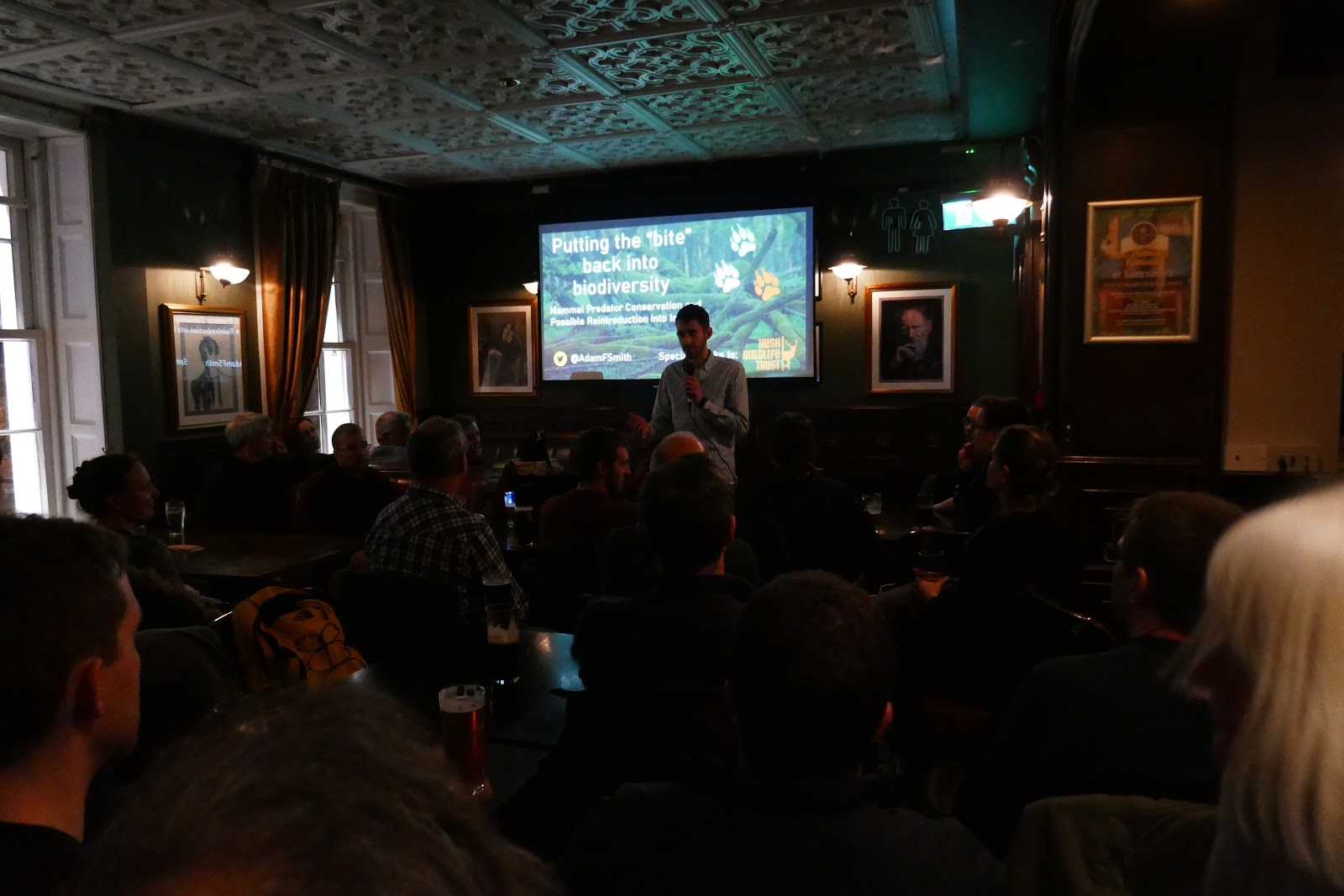
Green Drinks 3rd March 2020 - Putting the Bite back into Biodiversity?

The March Green Drinks talk was by Adam Francis Smith, who has a degree in Zoology and Master's on deer ecology from UCD. Adam has talked and written about mammals in Ireland, and is currently studying wolf and lynx populations for a PhD fellowship in Germany with the Frankfurt Zoological Society/University of Freiburg. Adam will talk about conserving our native predators, and about the possibility of reintroducing some of those we have lost. Time for the wolf to come back?

Adam gave a very interesting talk where he talked about the benefits of returning the wolf to Ireland as a keystone species that would help enormously in restoring wildlife habitats, by controlling deer numbers for example. But there are numerous obstacles to this at the moment, not least in winning the support of landowners and the general public. Reintroducing wolves would also have to be an All-Ireland initiative, as wolves don't recognise borders! Adam concluded by saying that, while it may not be practical in the short term for this to happen, in the long-term there is a realistic possibility of bringing back the wolf, if the right policies are pursued.


Tuesday, 14 January 2020

12th January 2020 - Bird watching Bull Island

IWT Dublin Branch went bird watching at Bull Island this January. Our guide was the excellent John Fox and there were lots of wintering birds to see along the causeway. We saw plenty of ducks, including pintails, shovelers, shelduck and teal. Other birds included curlews, godwits, lapwings and of course brent geese. There was a good turnout, and the weather was cold but dry. A satisfying morning's birdwatching was had by all.


7th January 2020 - Green Drinks Ireland through birds

January's Green Drinks was a drinks reception to celebrate the publication of 'Ireland through Birds' by Conor W. O'Brien. This fascinating and insightful book on some of Ireland's most elusive birds was launched by Dr. Tim Stott, TU Dublin. There was a great turnout on the night, and Conor sold a fair few copies! You can buy a copy of Conor's book from Merrion Press

The book launch was then followed by a talk by author and bird expert Anthony McGeehan on the birds of Inishbofin, which is a crossroads for migratory birds where unusual species such as North American warblers can be found. Inishbofin also has another advantage in that there are no magpies on the island!

5th November 2019 - Green Drink Forum on Natural Capital

November's Green Drinks talk was by Jane Stout of the Irish Forum on Natural Capital. The Irish Forum on Natural Capital (IFNC) brings together a diverse range of organisations and individuals from academic, public, private and NGO sectors who are interested in the development and application of the natural capital agenda in Ireland.

Jane explained the concept of Natural Capital as follows:

'Nature underpins our very existence on this planet, but it’s being destroyed at an accelerating rate. Although we have ethical and moral reasons for protecting it, public and private bodies often make decisions that affect nature, without taking it into account. The natural capital concept uses the language of business and accountancy to make the case for nature – to make it and its many benefits visible in decision-making processes, and so that we can account for our impacts and dependencies on nature. It’s not about putting a price on nature or commodifying it, it’s about making nature count.'

It comprises the world's stocks of physical and biological resources, including air, water, minerals, soils, fossil fuels and all living things. These stocks work together to deliver ecosystem goods and services that in turn provide benefits to society. 

You can learn more about the Irish Forum on Natural Capital through clicking on this link.


The IFNC Team


Monday, 13 January 2020

10th November 2019 - Fossil hunting in Portmarnock

In November the Dublin Branch went fossil hunting in Portmarnock near the Martello Tower. Led by Aodhán Ó Gógáin of TCD there was a good turnout to see some of the brilliant fossil beds next to us in Dublin.


27th October 2019 - Deer Rut, Phoenix Park

The Dublin Branch had its annual outing to see the fascinating annual deer rut in the Phoenix Park, led by Margaret McGuirk of the OPW. In late Autumn each year the Fallow Deer bucks mate, with a spectacular display of 'maleness'. The fact that the Dublin City Marathon organised their event the same day did not prevent a good turnout. Those attending saw some good scenes of bucks locking horns in their quest to secure a mate. You can learn more about the deer from the Phoenix Park's website


1st October 2019 Green Drinks - Cherish Project

The October Green Drinks talk was by Kieran Craven of CHERISH (Climate Heritage & Environments of Reefs, Islands and Headlands).  CHERISH is an EU funded Ireland - Wales project, that will increase cross-border knowledge and understanding of the impacts (past, present and near-future) of climate change, storminess and extreme weather events on the cultural heritage of reefs, islands and headlands of the Irish Sea. This will be one of the most important ways that Ireland will be affected by climate change, so it is important to understand its impact.


Monday, 9 September 2019

25th August 2019 - Rockpooling in Portmarnock

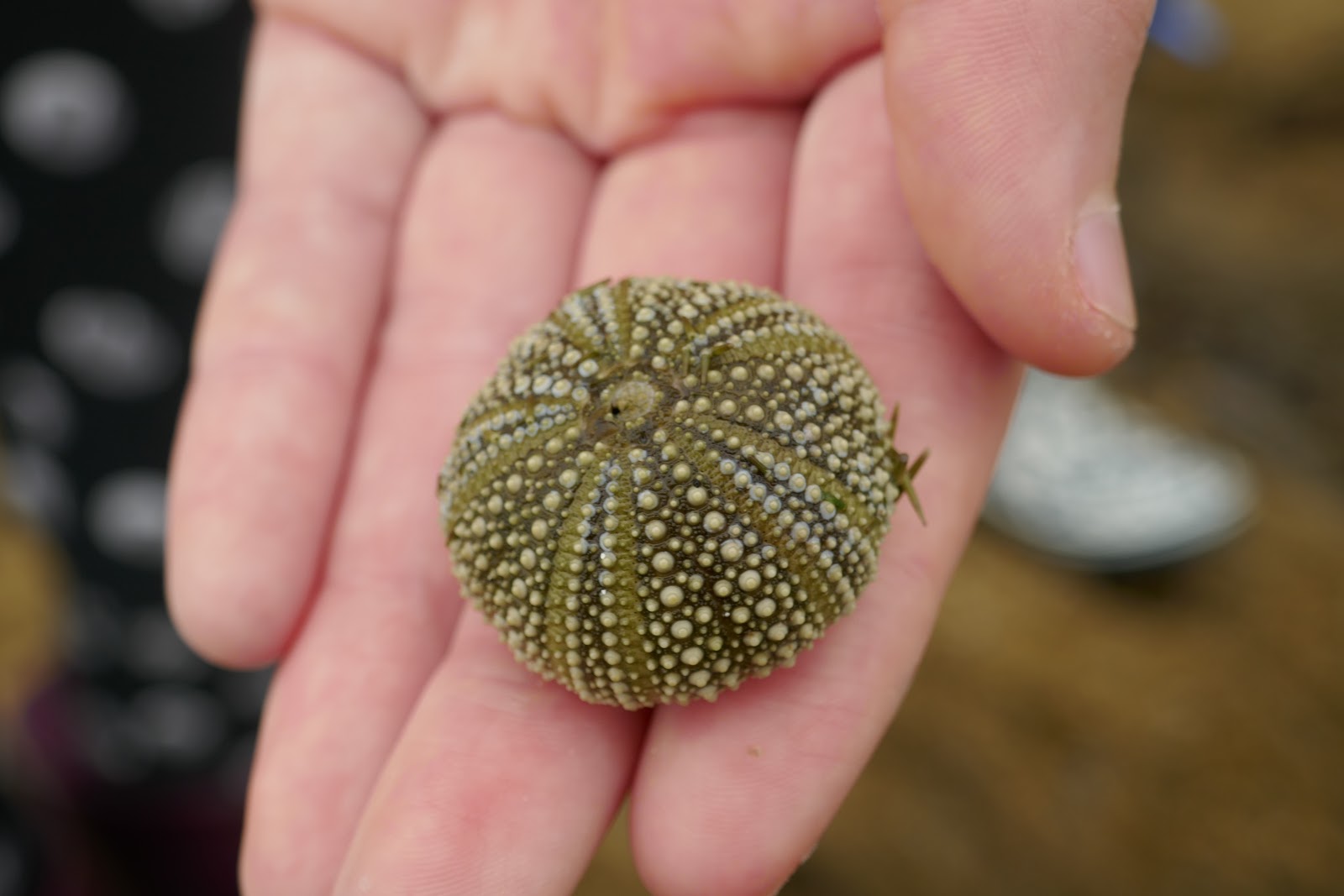
The August outing of the Dublin Branch of IWT saw us rockpooling in Portmarnock, led by our knowledgeable volunteers Kevin and Leyla. Overall there were some 35 participants - mainly young kids, and the weather was fine, but a bit dull. Kevin and Leyla were absolutely wonderful, and helped everyone to find lots of really cool things. As well as both brittle starfish and a common starfish, some fish species were found including Rock Goby, blenny, butterfish and a 5 bearded rockling.

Other highlights included a nudibranch - orange clubbed sea slug (Limacia clavigera), which was feeding on the sea mats (bryozoans) attached to rocks in the rock pools. We also found Elysia viridis, or the sap-sucking slug (photo below).

Some of the birds that hung around with us during the rockpooling included cormorants, common tern, heron gulls, greater black-backed gulls, oystercatcher and turnstones.

As well as all the wildlife, Kevin and Leyla talked to the children about marine pollution (plastic), and sure enough several kids picked up plastic items which they found in the rock pools. a very enjoyable and enlightening day was had by all.


Monday, 15 July 2019

7th July - Bull Island Wildflower Walk

Dublin Branch held its annual Bull Island wildflower walk led by Niall Mac Coitir of IWT Dublin Branch. This was a particularly good year, with an amazing variety of wildflowers to be seen, including six species of orchid! The six species were early purple orchid, common spotted orchid, pyramidal orchid, marsh helleborine, twayblade, and the elusive bee orchid. Other wild flowers seen were lady's bedstraw, restharrow, wild violets, hares foot clover, bird's foot trefoil, centaury and eyebright. It is not an exaggeration to say that the display rivals anything that can be seen in the Burren.

Common Spotted Orchid

Another common spotted
- they come in a variety of colours


Twayblade orchid with its green flowers

Wild Violet or pansy


Marsh Helleborine

Pyramidal orchid

Green Drinks 2nd July - Marine Protected Areas

For July's Dublin Green Drinks Regina Classen, of the IWT talked about the aims of the Bigger and Better Marine Protected Areas (MPA) initiative. Regina, IWT co-ordinator, campaigns in partnership with Coastwatch and Seas at Risk to promote the establishment of a Marine Protected Areas Network. MPAs are a proven way to achieve much needed ecosystem restoration, sustainable fishing and climate change mitigation. In theory, MPAs provide safe havens for animals and plants to grow and reproduce without the threat of human activity. An properly policed and extensive MPA network would provide a vital safe haven for wildlife. You can read more about the MPA campaign on the IWT's website: IWT Campaign 'Bigger and Better'


Monday, 1 July 2019

June 9th and 22nd - Ireland's Eye Trips

Dublin Branch held its annual Ireland's Eye trips on 9th and 22nd June, and as usual both trips were booked out. We were lucky with the weather as there was no rain, and our guide John Fox did an excellent job on both occasions. However, there were altogether fewer birds and chicks than in the past, and NO peregrine Falcons. There was also an unusual profusion of Hogweed everywhere. Despite this the trips were both enjoyable and informative.


Thursday, 23 May 2019

Green Drinks 7th May - Field of Dreams

This month Bob Salisbury told of how he and his wife Rosemary transformed a barren corner of County Tyrone into a wildlife haven. When they took over the land it was a sterile landscape for wildlife, with open boggy fields that had been let go fallow. However Bob and Rosemary began a programme of tree planting and they created a series of ponds to drain off the flooded land, which led to a resurgence of wildlife.

Their renowned wildlife garden is now home to hares, owls, hawks, otters, woodcock, bats and many other species that hadn’t been seen in the area for years. It has become what Bob calls his FoD - 'Field of Dreams' and he has published a book about his experience https://blackstaffpress.com/…/field-of-dreams-how-we-trans…/


2nd April - People for Bees

This month's Green Drinks is about the IWT People for Bees programme. The alarming decline of our bees and other insects is clear, but what can you do about it? The People for Bees programme aims to support communities and individuals in Ireland to take action to help fight bee decline. IWT Coordinator Kieran Flood provided an update on our People for Bees plans for 2019 to let you what you can do to help out, including making your gardens and green spaces more pollinator friendly. Volunteers can also learn field skills like bee identification, bumblebee monitoring and biodiversity record taking. The project is aimed at community groups and members of the public in every province of Ireland.

You can learn more about this important initiative on the IWT website: https://iwt.ie/people-for-bees/

Kieran at a bee identification workshop


31st March - Killiney Beach Walk

This month Kieran Craven of CHERISH brought us on a walk along Killiney Beach. CHERISH (Climate Heritage & Environments of Reefs, Islands and Headlands) is an EU funded Ireland - Wales project, that will increase cross-border knowledge and understanding of the impacts (past, present and near-future) of climate change, storminess and extreme weather events on the cultural heritage of reefs, islands and headlands of the Irish Sea.

Kieran told us all about the the geology of the Killiney Beach area, including the fascinating fact that granite from Ailsa Craig in Scotland is to be found on the beach - carried there during the last Ice Age! Kieran also told us how the whole of Dublin Bay is at risk from rising sea levels due to Climate Change.

You can learn more about the CHERISH Project at http://www.cherishproject.eu/en/


Kieran talks about tectonic forces

A look at some of the different rock types to be seen


Coastal erosion is happening at Killiney
and will only get worse with climate change